

One of the aspects that financial institutions most frequently misunderstand involves the Payment Card Industry Data Security Standard (PCI DSS) requirements for ATM monitoring systems. While PCI DSS 4.0 has a multitude of requirements that all ATMs must comply with, there’s a crucial distinction that many organizations overlook: the monitoring system itself may not require PCI DSS certification when properly configured to handle only masked cardholder data.
This distinction has significant implications for financial institutions implementing comprehensive ATM monitoring solutions like NetXMS, which has successfully completed ATM monitoring deployments worldwide that have achieved PCI DSS certification. Not because the monitoring software itself required certification, but because the overall ATM infrastructure setup met compliance requirements.
Understanding PCI DSS Scope and Cardholder Data
The foundation of PCI DSS compliance lies in understanding what constitutes cardholder data and how it defines the scope of compliance requirements. PCI DSS is an information security standard used to handle credit cards from major card brands, created to better control cardholder data and reduce credit card fraud.
The key to understanding why ATM monitoring systems can operate outside PCI DSS scope lies in distinguishing between different types of card-related information:
Primary Account Numbers (PANs): The full 16-digit card numbers that require the highest level of protection under PCI DSS. Any system that processes, transmits, or stores complete PANs falls within PCI DSS scope and must meet all applicable requirements.
Masked or Truncated PANs: Organizations can mask PANs when they are displayed, ensuring truncated PAN cardholder data displays only a maximum of the first six and last four digits at any time. This masked data significantly reduces compliance requirements.
Electronic Journal Data: ATM transaction logs that contain transaction details but use masked card numbers instead of complete PANs for security purposes.
When an ATM monitoring system is configured to receive only masked card numbers in electronic journals and operational data, it does not handle complete cardholder data that would trigger PCI DSS compliance requirements for the monitoring platform itself.
How NetXMS Operates Outside PCI DSS Scope
NetXMS ATM monitoring implementations demonstrate how sophisticated monitoring capabilities can be achieved while maintaining separation from sensitive cardholder data. The architecture accomplishes this through several key design principles:
Data Masking: ATM terminals mask cardholder data before transmitting information to the monitoring system. Electronic journals contain transaction records with masked PANs that show only the first six and last four digits, providing sufficient information for operational monitoring while eliminating exposure to complete cardholder data.
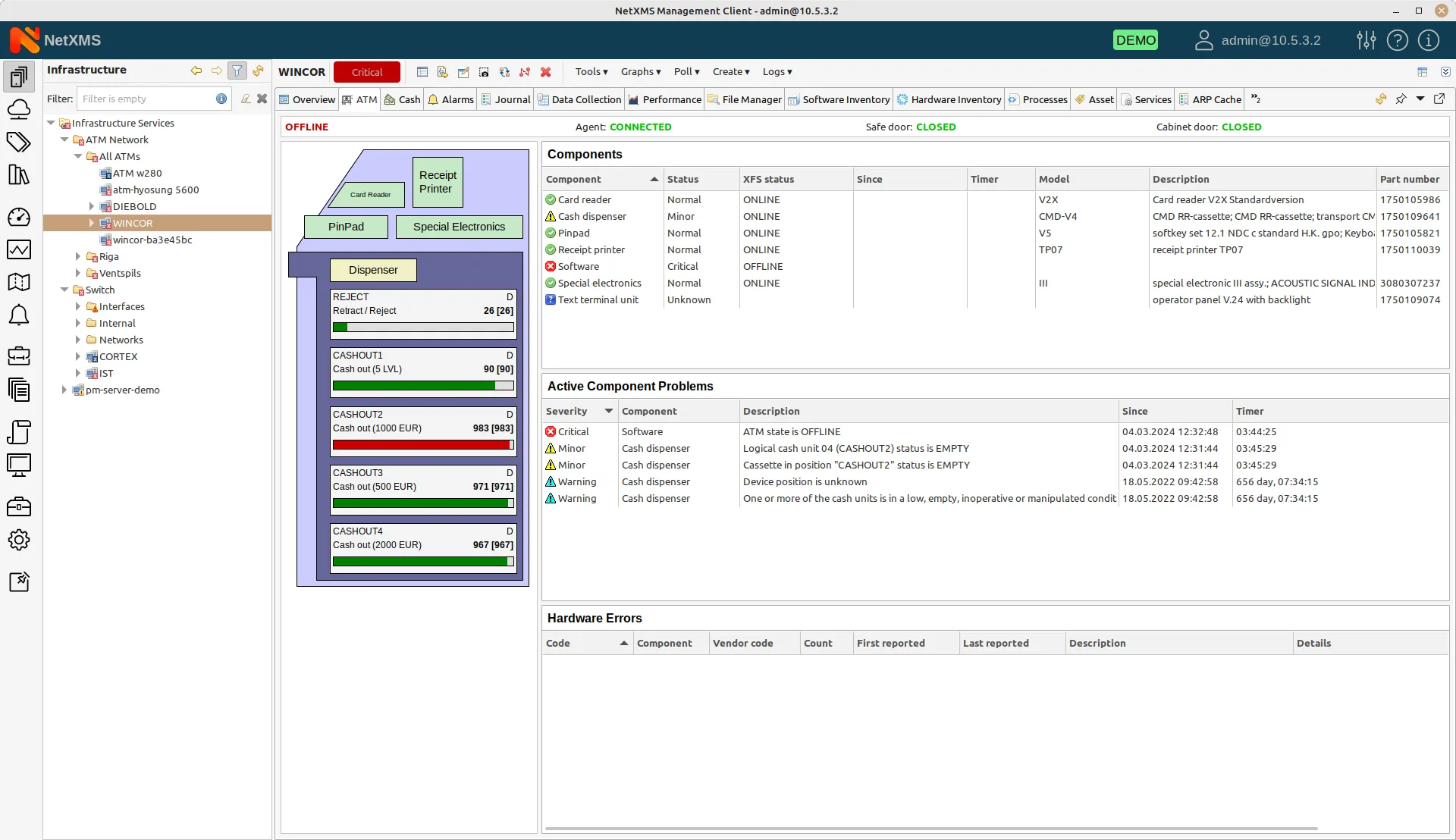
Operational Data Focus: The monitoring system primarily handles operational metrics such as cash levels, hardware status, network connectivity, transaction counts, and system performance data. These operational parameters provide comprehensive monitoring capabilities without requiring access to sensitive payment information.
Encrypted Communication Channels: While not driven by PCI DSS requirements for the monitoring system, NetXMS employs industry-standard encryption for all communications between ATM terminals and monitoring servers. This encryption protects operational data and maintains system security integrity.
On-Premises Deployment Model: An additional critical factor in compliance responsibility is that NetXMS operates as an on-premises solution deployed within the financial institution’s own infrastructure. This deployment model means that data handling requirements, security implementations, and compliance responsibilities remain entirely within the organization’s control and jurisdiction. NetXMS provides the monitoring platform and technical capabilities, but the institution maintains full ownership and responsibility for data governance, security policies, access controls, and compliance adherence. This on-premises approach eliminates concerns about third-party data processing and ensures that sensitive operational information never leaves the organization’s controlled environment, further simplifying compliance frameworks and risk management considerations.
In this way, NetXMS provides comprehensive ATM monitoring capabilities while operating outside the direct scope of PCI DSS requirements that apply to systems handling complete cardholder data.
The Certification Reality: System-Specific, Not Software-Specific
A critical misconception in the financial services industry involves the belief that monitoring software itself requires PCI DSS certification. In reality, PCI DSS 4.0 compliance is required for organizations based on their specific implementation and data handling practices, not for software products in isolation.
NetXMS has completed successful ATM monitoring implementations across diverse global markets, each presenting unique regulatory and operational challenges. These deployments demonstrate the platform’s ability to support PCI DSS-compliant ATM operations while providing comprehensive monitoring capabilities.
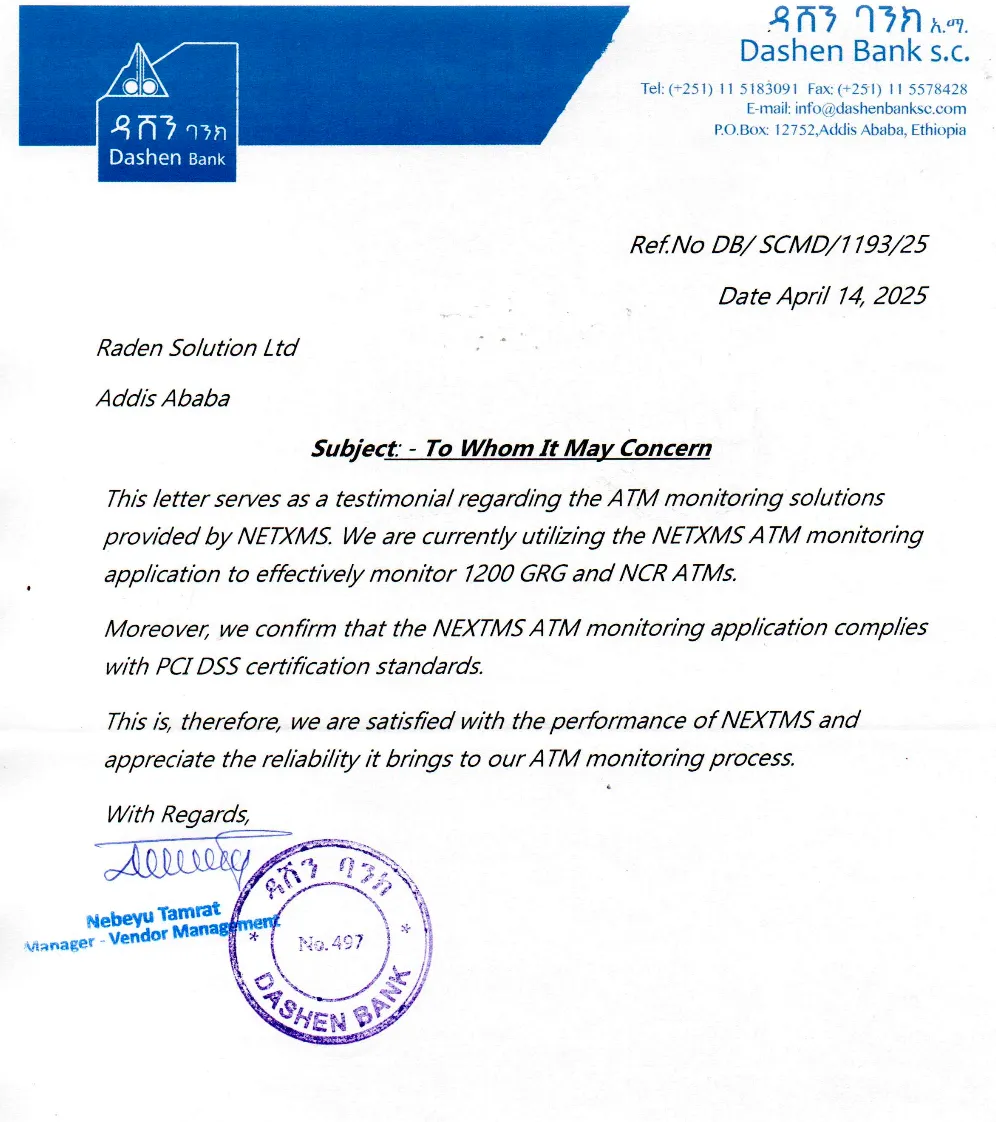
A written testimonial from a client in Ethiopia, confirming NetXMS ATM monitoring system’s compliance with PCI DSS certification standards.
These implementations achieved certification not because the NetXMS software required it, but because the overall ATM infrastructure — including payment processing systems, network security, access controls, and data handling practices — met PCI DSS requirements for the specific deployment environment.
Certification Applies to Implementations: PCI DSS compliance assessments evaluate complete systems and their operational environments. The same monitoring software can operate in both PCI-compliant and non-PCI environments depending on the data it handles and the security controls implemented around it.
Configuration-Dependent Compliance: When NetXMS is configured to receive only masked cardholder data and operates with appropriate security controls, the monitoring system itself falls outside PCI DSS scope while supporting overall infrastructure compliance.
NetXMS integrations with PCI-compliant ATM networks maintain compliance through proper data handling, network segmentation, access controls, and audit capabilities that support the broader compliance framework.
Risk Management and Security Best Practices
Even when operating outside direct PCI DSS scope, NetXMS implementations incorporate security best practices that align with compliance frameworks and risk management principles:
Data Minimization: The system collects and stores only the operational data necessary for effective ATM monitoring and remote management, minimizing data exposure and reducing potential compliance complexity.
Regular Security Updates: Continuous platform updates and security patches ensure that monitoring infrastructure maintains high security standards even when not directly subject to PCI DSS requirements.
Incident Response Integration: NetXMS can integrate with existing incident response procedures and security operations centers, supporting rapid response to potential security events across ATM networks.
Vulnerability Management: Regular security assessments and vulnerability management practices ensure that monitoring infrastructure doesn’t introduce security risks to the broader ATM environment.
Monitoring systems can be deployed and modified more rapidly when they don’t require PCI DSS compliance validation for every change. However, financial institutions considering ATM monitoring implementations should still think ahead and adopt strategic approaches that optimize compliance, security, and operational effectiveness.
Intelligent Compliance Through Proper Configuration
The distinction between PCI DSS-compliant ATM networks and PCI DSS-certified monitoring systems represents a crucial understanding for modern financial institutions. NetXMS has demonstrated through numerous global deployments that sophisticated ATM monitoring capabilities can be achieved while maintaining clear separation from sensitive cardholder data that would trigger direct PCI DSS compliance requirements.
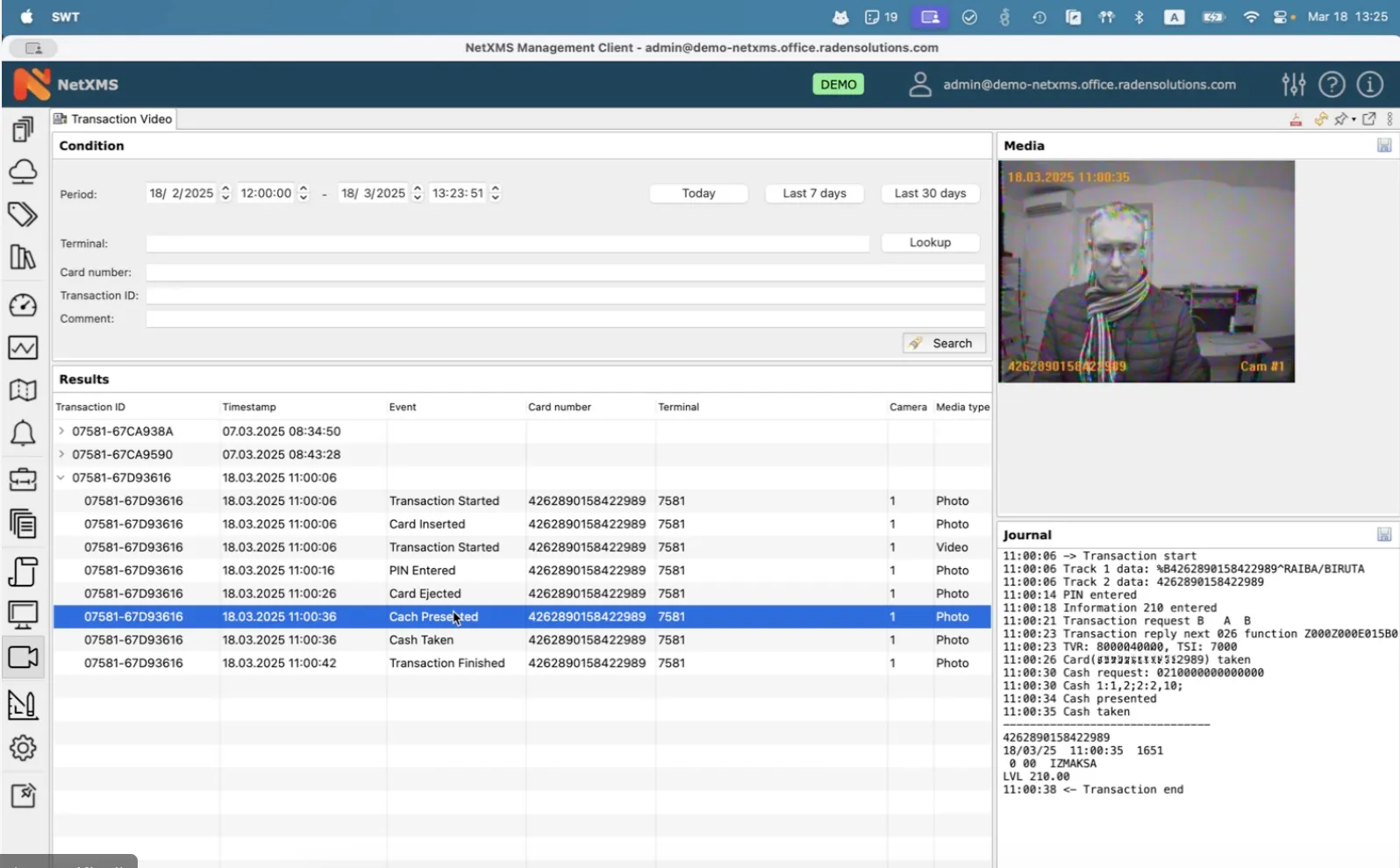
By configuring monitoring systems to handle only masked cardholder data and operational information, organizations can achieve comprehensive ATM network visibility while focusing compliance efforts on systems that actually process complete payment card information. This approach doesn’t compromise security or operational effectiveness. Rather, it optimizes resource allocation and reduces compliance complexity.
NetXMS’s track record of supporting PCI DSS-compliant ATM deployments worldwide demonstrates that monitoring excellence and compliance efficiency can be achieved simultaneously through intelligent system architecture and proper configuration. As financial institutions continue balancing operational requirements with regulatory compliance, understanding these scope distinctions becomes increasingly critical for successful ATM network management.
The key insight for decision-makers is clear: focus PCI DSS compliance efforts where they matter most (on systems handling complete cardholder data) while leveraging monitoring solutions that provide comprehensive operational oversight without unnecessary compliance overhead. This strategic approach enables organizations to maintain the highest security standards while optimizing operational efficiency and compliance costs.
For detailed consultation on PCI DSS-compliant ATM monitoring implementations and proper system configuration, contact the NetXMS compliance team at [email protected]